The Land. The Women. Their Stories. An Environmental Perspective
An Environmental Perspective.
Gunnison County’s rural and remote landscapes span 3,260 square miles, shaping a rich and diverse history tied to its geology, waterways, and natural resources. The region boasts abundant water resources and a diverse topography, with mountain peaks reaching up to 13,000 feet. The Ute people, the earliest known inhabitants of the area, maintained a deep, reciprocal relationship with the land, rooted in hunting and gathering.
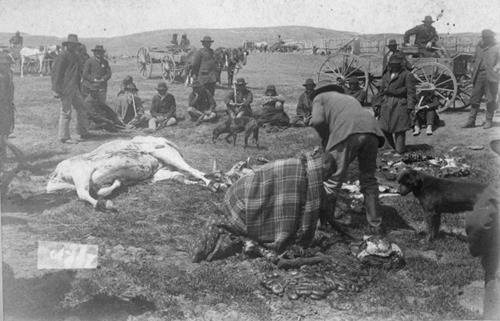
Within the Gunnison Valley, the Parianuches, also known as the “Elk People,” lived north of the Gunnison River, while the Tabeguache, later referred to as the Uncompahgre, resided in the western region. Their stewardship of the land long predated the arrival of white settlers, who sought gold, silver, coal, and other minerals, leading to complex and often fraught interactions between the two groups. Eventually, the Ute were forcibly removed, sometimes violently, through a series of treaties—many of which were broken.
Ute men butchering cattle at the Los Pinos Indian Agency in Sagauche County, Colorado. A group of men sit on the ground and watch, while a line of horse-drawn carraiges waits behinds them. Photographed circra 1885 by an unknown photographer. **The Los Pinos Indian Agency, located in Saguache County near the Cochetope Valley on the border of Gunnison and Saguache Counties, was established following the Treaty of 1868 to serve the Uncompahgre and Tabeguache Ute bands. The agency provided cattle to the Utes, but by 1881, both bands were forcibly relocated to a reservation in Utah. After its closure, local Gunnison residents bought the land for ranching. Photo Credit: The Colorado Collection, History Colorado, 1885, Object ID: 95.200.943.
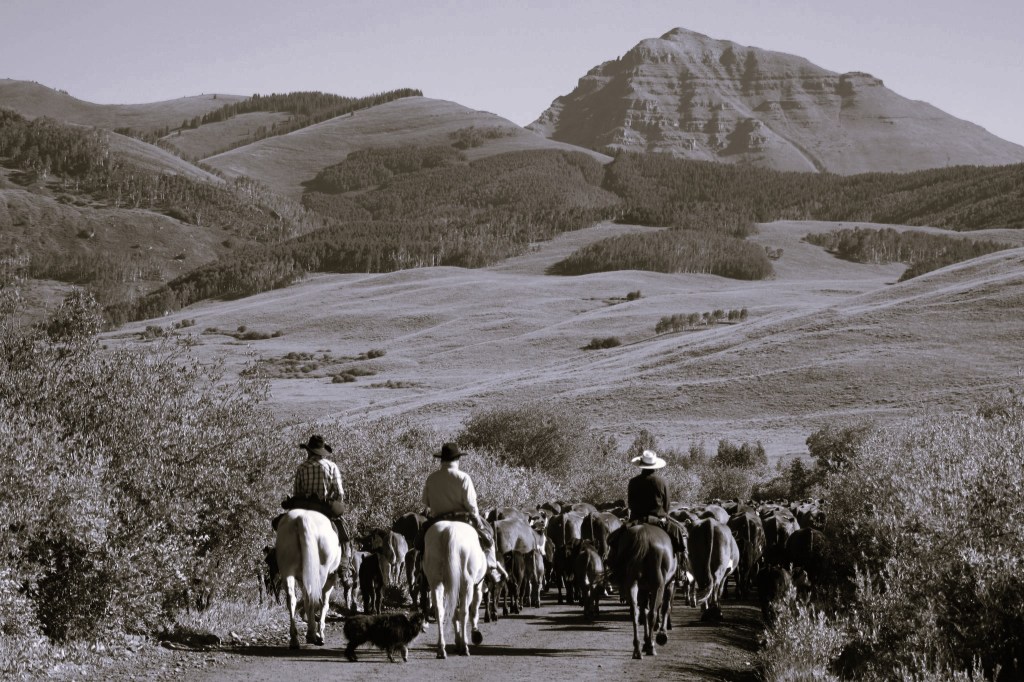
As mining boomed, ranchers in Gunnison County cleared sagebrush and dug irrigation ditches to bring water to remote ranges. By the 1870s, these efforts marked the beginning of open-range cattle ranching, which supported miners with beef and hay. The arrival of railroads, such as the Denver Rio Grande and the South Park Pacific, in the 1880s opened new markets for local ranchers, further transforming the physical landscape as ranches expanded throughout the valley, marking the boom of the cattle industry.
A view of the pastures in Crested Butte South, looking north toward Crested Butte Mountain in the distance. Photo Credit: Anders J. Ipsen.
The land shapes the animals that roam it and the people who work it. Women in this project highlight the challenges of high-altitude ranching, with elevations in the Gunnison Valley ranging from under 6,000 to over 14,000 feet. Lower areas, such as Quartz Creek and Tomichi Valley, support early-season grazing, while ranchers move their cattle higher as the season progresses.
Altitude inevitably affects cattle, and many women in this project raise and manage Hereford-Angus crossbreeds, a breed known for its resilience to high elevations and extreme weather conditions. These women discuss how altitude affects livestock, particularly brisket disease (bovine high mountain disease), which is caused by low oxygen levels and pulmonary hypertension when cattle are moved into high-altitude pastures, such as those north of Crested Butte or near Taylor Park. Managing this risk requires selective breeding, with the Hereford-Angus mix proving exceptionally resistant. This challenge is just one example of how ranchers have adapted to the environment over the past 160 years.
A Hereford cow grazing near Brush Creek, Crested Butte, Colorado. Photo Credit: Anders J. Ipsen.
By the 20th century, ranching had become a vital component of the valley’s economy. The area endured tough times, including the Great Depression, two world wars, and severe droughts, but significant changes were on the horizon. The opening of Crested Butte Mountain Resort in 1961 marked the beginning of a new era in the region, dominated by recreational tourism. This development drew new visitors, contributed to the area’s growth, and posed new challenges for the open-range cattle operators.
At the same time, advances in ranching technology modernized the industry, rapidly transforming the landscape. The introduction of tractors mechanized hay production, increasing yields and reducing the need for manual labor.
While women had always contributed to ranch work, their roles often depended on circumstance—some participated in open-range activities. In contrast, others were relegated to domestic duties, and some did both. By the late 20th and early 21st centuries, however, an increasing number of women held leadership positions in the industry. The founding of the Gunnison Valley Cattlewomen in 1951 marked a significant shift in the social landscape, challenging the notion that ranching was a solely male domain.
Despite their deep ties to the land, women’s contributions to ranching have often been overlooked. Since the 1860s, ranching history has largely been told through the experiences of male ranchers, with women’s roles either sidelined or minimized. However, women have not only shaped the land but have also been shaped by it. Their labor, knowledge, and adaptability were crucial to the endurance of ranching. Living in this environment, they faced a different set of challenges and opportunities compared to their urban counterparts, which influenced how they saw themselves and navigated the world. While their stories have often gone untold, these women played an integral role in shaping the landscape, and their impact continues to resonate, even if it hasn’t yet been fully recognized.
This project showcases women ranchers across regions that are shaped by environmental and economic challenges, including tourism, development, and rising costs. The areas covered include Cochetope, Quartz Creek, Gunnison, North Gunnison, Ohio Creek, Taylor Park, Jacks Cabin/Crested Butte South, Crested Butte, North Valley, and Powderhorn.
For this exhibit, these regions are divided because they are ecologically and climatically distinct, each producing different variations of hay with varying access to water and other resources. Each woman is shaped by the environment in which she works.
The Women. Their Stories.
Below, please click on the edited oral history snippets to listen to the women of this project share their deep connection to the land. Their stories reveal how the environment has shaped their lives—and how, in turn, they have left their mark on it. For those who are hearing impaired, text transcripts are available below each audio clip.
Stacy McPhail
“The first part of our mission is preserving ranch lands.”
Audio Transcript: Using advocacy and being involved in policy making is important. But if we don’t have the scientific data to back up what we do and how we do it and understand what’s good about it and what isn’t, then we’re kind of chasing our tails. And the ranchers I’ve worked with in the last 15 years of all told me that they’re afraid of those things. So I saw a role I could play in supporting ranching. It addresses the second part of our mission. The first part of our mission is conserving ranch lands. The second part is preserving ranching. So by owning and operating a commercial cow calf operation, we are a part of the preservation of ranching. But to what end and to what public benefit. So my job is to tie in public benefit from, from this gift and our non-profit activities. With strengthening the community and strengthening the understanding of the practices within ranching. And I believe that that’s possible through research. And engaging in collaborative research specifically. So that’s part of my job in ranching as well. We have a ranch in order to allow for some of these things to happen. And so my goal is to continue to study the interactions of a commercial cow calf operation on the ground. Consideration when you’re ranching in high mountain areas. And there’s very, you know, there’s limited research. Bill and his family at the, the Trampe family have always engaged in research on cattle genetics. So we’ll continue that.
”We have a lot of irrigation water rights. So what happens in the Colorado River will affect our ranch.”
Audio Transcript: I like to irrigate a lot. I love it. It’s the combination of. Natural resources. And, um, manage man’s management. And you get to, it’s very natural. You feel like you’re taking a hike or a walk. You’re doing something constructive that Oh, interesting. It’s one of the few things that we can’t mechanize. You can’t mechanize irrigation to that level. For us, it’s low technology. And because we only cut one hay crop a year. We will never have the money to go in and put in huge, you know, very technologically oriented systems when you’re only using the water for two months out of the year. These are, these are ditches that people actually dug on their hands and knees. So, for instance I asked Bill Trampe many years ago you why you want to conserve this, but also why do you wanna give it away? And the thought is is, you know, there’s a lot of pressures. It’s difficult to keep a ranch and ranching and it’s a lot of liability and a lot of work. And they have a small family. They’ve always had small, they’re not a large family. And he said, you know, I can’t bear the idea that someone would [00:01:00] pave over this meadow and my grandfather was on his hands and knees digging these trenches. So, I mean, there’s something tangible there. The Trampe family is, is unusual. But the gift that they gave us in the way that they gave it is continues to make that a historic operation . That continues with more support, and a better understanding in the future of what that resource can provide to other people in the community. And how we can use it for research. So. A big part of what I do is kind of coordinate research opportunities on the ranch. So we’re engaged in a five year soil carbon study currently. And we have a carbon tower installed last year. So on the ranch last year for instance, on a day in September is I met with 18 scientists from five different public universities and they installed instrumentation. And a carbon soil carbon tower. We’re the highest site elevation site in their national study. And we believe it’s important to understand soil health so that what we do can either be defended or improved. And so I’ve had to be on the side of administration and policy making for a long time. And I advocate for ranching and land conservation a lot. And now I advocate slightly differently. I advocate in the water world. We have a lot of irrigation water rights. So what happens in the Colorado River will affect our ranch.
Barbara East
“It was the land.”
Listen to how Barbara shares her initial thoughts on the expansive open ranges of Gunnison County, recalling her drive to the valley from the Front Range with her father in 1967. Although she initially had a deep affection for horses, she explains in the clip that “…it was the land” that genuinely captivated her. Barbara came to understand her desire to engage with and nurture the land.
Audio Transcript: I think it was 1967; I came to Gunnison with my dad. He sold a hay machine. He was an equipment dealer and handled Haymaster. And we sold a machine to Little Landing Cattle Company. And I got to come up with Dad. And I wanted to see those workhorses because I always drew horses. And I think just driving off of Monarch, and I remember this so distinctly, driving up Ohio Creek, looking at all that land and nothing on it. It was the course of the winter. It was this huge expanse of open meadow or rangeland. And coming from in the front range, you just did not see that like that. It’s more broken over there. And I just loved it. And the horse thing went out the window. It was the land. And so the following winter, that winter, I kind of ruminated on that. And I wrote Sam and Margaret Little a letter and asked them if I could ride for them. Because I did quite a bit for the Hogans over there and mowed hay. And they said they had a rider, but I could come mow hay, because they didn’t want to hurt my feelings. And so I jumped right on the hay job, like, oh, God, what are we going to do with her? And so I mowed hay for them for four years.
Kathleen Curry
“The East River and Ohio Creek drainages have had to deal with a lot more interaction…” Audio Transcript: Well, depending on where you are in the county, you had more impacts in areas with heavy recreational use. For example, the East River and Ohio Creek drainages, I think have faced, have had to deal with a lot more interaction. And it also depends on if you run cattle on BLM allotments or forest allotments. So the guys that are using the forest and that are in the area where there are more recreational users, I think it’s had a really significant impact on them. For us, where we’re at, less so, but it’s starting to be discovered. So more and more people are using the BLM now and not always going to the forest. And I think that’s because of overcrowding and they’re looking for, they’re looking for a more high quality experience. So we see more bicycles and we see more motorcycles out here now than we used to. And I, that’s probably a reflection of changing demands and folks wishing that they could get away from the crowds up in Gothic and in that country. So I think that we’re also seeing more trespassing on private. It’s not always malicious. They just don’t research where they’re at.
Jeannie Miller
“You had your horses and your small equipment.”
Audio Transcript: Well, in the sixties, for example, up at Ohio Creek, there were probably twenty different small ranches. And you did a lot of it very manually. And you had your horses and your small equipment. And, for example, on our place, it would probably take six weeks to do the hay. And by the time you got all your big balers and everything in the nineties, you could do it in ten days.
Jan Washburn
“A lot of damage that goes unchecked…”
Audio Transcript: The influx of of the tourism economy that go unchecked not to criticize the agencies that don’t have enough people to patrol it or enforce it or but just there’s so many out on the resource all the time and doing a lot of damage that goes unchecked it’s hard to reverse
Irene Irby
“Hay’n time was my favorite.“
Audio Transcript: Haying time was my favorite. I just loved the hay field. I just grew up, well I worked. Then they had stackers where they put the hay on this and they loaded the hay and threw it off on the stack and my dad was, and he had the hired man, they were the only two that worked on the stacks and I mean to tell you it was work but those they just continually kept the hay going so as I got older I ran the buck that put the hay on the stack. My sister and I did that too and I think I was 11 when they had a cat, the cat, daddy had a cat, caterpillar and it was hooked up to ropes and then it would it would take the load up and I had to release the ropes and it was kind of a boring thing but we did, it was a, I loved it but it was a long day and we’d go in at noon to eat our dinner.
Margaret Vader-Funk
“People are getting protective over their water rights.”
Audio Transcript: Margaret Vader Funk: People are getting more protective of their water rights. There’s well, up on the Cochetope right across where. Our house is . Up Nick Myers, years ago, probably in the, I don’t know, sixties, maybe earlier than 1960s. One rancher over on the Doyle claimed another rancher was stealing his water. And the one rancher shot the other one and went. Over the hill and went up. . And so that became the name of the The draw. . And it was a fight over water. And you have water rights, but you have senior water rights. And what people don’t realize, well, like California and Nevada . Want all of our water. But if you leave the water in the creek it doesn’t have a chance to spread out in the meadows. Which keeps Springs active. So if you keep your meadows wet, you will have more water going down rather than if you keep it just in the crick.They were drilling for uranium on the ranch below us . And lost their. Drilling outfit fell in a hole. And artesian water started there. Well, they wouldn’t shut the artesian water off in the winter when they didn’t need it for irrigation. So it dried up our spring at our ranch. So we had to drill a well in order for us to get water. Because the artesian water was taking the ground water and drying up springs right around the. The whole area.
Fay Vader
“When I first started working out in the hayfields, what was I, 11 or 12 years old”
Audio Transcript: Well, I don’t know. I mean, when I first started working out in the hayfield, what was I, 11, 12 years old or something, I was a little tiny, skinny thing. And my, you, you wanna really wanna know what the biggest challenge in the morning was? Hooking up my team to my mower. ‘ cause I couldn’t lift the. I couldn’t lift it up there and get ’em hooked up so, and I, I wouldn’t admit that I couldn’t lift it. Those big tongues and double tree and single treason and hors, they were heavy. And I was, would not admit that I couldn’t lift him, you know? I was a little bit whatever. But we had a hired man and he saw me struggling out there one day. He was he was a stacker. And he came out and he said, FA, he said, you’re having a hard time doing that, aren’t you? And I said, yeah. And so he helped me every morning after that. But now the Mower tongues, they were heavy the rake I didn’t have any trouble with, but those big mower tongues, they were heavy and you had to lift them. And I wasn’t about to admit that I couldn’t do it, but I was so glad and that stacker man came out and helped me every morning after that.
Nola Davis-Means
“Damn it Derrick…close the gate!”
Audio Transcript: We’ve got one, all our gates we have trouble with, and we both doubled over laughing because we have found that rather than using for service signs that tell you that, that we’ve made homemade signs. That works better. And it does work better, and it says close the gate.And someone had gone through and put a sticker and it says, dammit Derek, close the gate. That gate has always become the dammit Derek gate. That is the best story of the day. I said I’m going to go get a bunch of those stickers, all of them, thanks for the help. We have the for service ones, and I think we’re going to quit using them because they are ineffective. And they say, please leave gate open or in the fall, please close gate and you have to wire them all together and they take forever. People have now started flipping them. And they say, please leave gate open, then they wire the gate back to a post. And it’s in the fall that we have the most trouble when they have the big events. And so I think even a note and a baggie works pretty well because it catches their attention. But then in the brochure I did the, here’s how you close the gate, and I used a girl, you know, with a, how to put your arm around the gate and that. And I think we ought to actually have that on the gates too. And I’ve had for service permission, I just haven’t done them yet. We kind of switched all over to swinging gates, so. We have to. Not only would they not close it, they drive over it and break them, they take them apart and leave them. Or they wear them out. It’s just like, just close the gate. They just wear them out in our country. They just pretty soon, it’s like breaking wire, you know, and pretty soon they’re, and some people try to fix them, and that’s scary too, the way they fix them, but they try.
Trudy Vader
“We all dug worms as a family, it was a supplemental income.” Audio Transcript: And then we all dug worms as a family because that was a supplement income. And can you explain that? Worms for fishermen and we got a penny a worm and based upon your age, determined how many cans of worms you had to dig. But by the time I was in first grade, I could, I could count to 50. Pretty slick because, yeah, because you had to dig worms. Where did you guys sell them at? Right off the highway and then also at Hanson’s hardware, which is now the art center. But so all six kids were involved in that. So you had six brothers and sisters, yes. And it didn’t matter what time of day you dug the worms. You were just expected to do it. Okay. So we all learned to go out early in the morning and get it done.
LaDonna McClain
Audio Transcript: When we bought the ranch, we put ear tags on our cows. We preg checked all those cows, made sure they were, there’s several different ways, but what we did was hire a vet to go in with the mom, gloves, to feel around, to see if there’s a baby there. And sometimes he’d come up and say, you got a set of twins in this one, you might write down the number. And of course I was involved. I was out there pushing cows around to get this done. But my father-in-law wasn’t into putting ear tags on and we had some trouble in the neighborhood because funny thing, our calves had disappeared and they might be on the other side. And if you weren’t watching and they were calling their momma, somebody had stalled them, very important. And that was, we knew when we vaccinated calves and I was in on there, we vaccinated from a truck before we branded. That was very important in our lifestyle. And that way we could eliminate the cows that weren’t going to have calves. We could sell as heiferettes, steers. And then you try to, when we bought the ranch, the cows were about 14 years old and we brought them down to 10. We kept eliminating and eliminating because we had to go to high altitude and they get older, they don’t take the altitude.




 Crossing Fenceposts An Oral History of Ranch Women in Gunnison County, 1965-Present
Leave a comment